
Product guidance
Auditing WhatsApp Conversations: How to Detect and Recover Unfulfilled Customer Promises
Learn how to build a WhatsApp conversation audit workflow to detect inbox drift, review unfulfilled customer promises, and support service recovery.
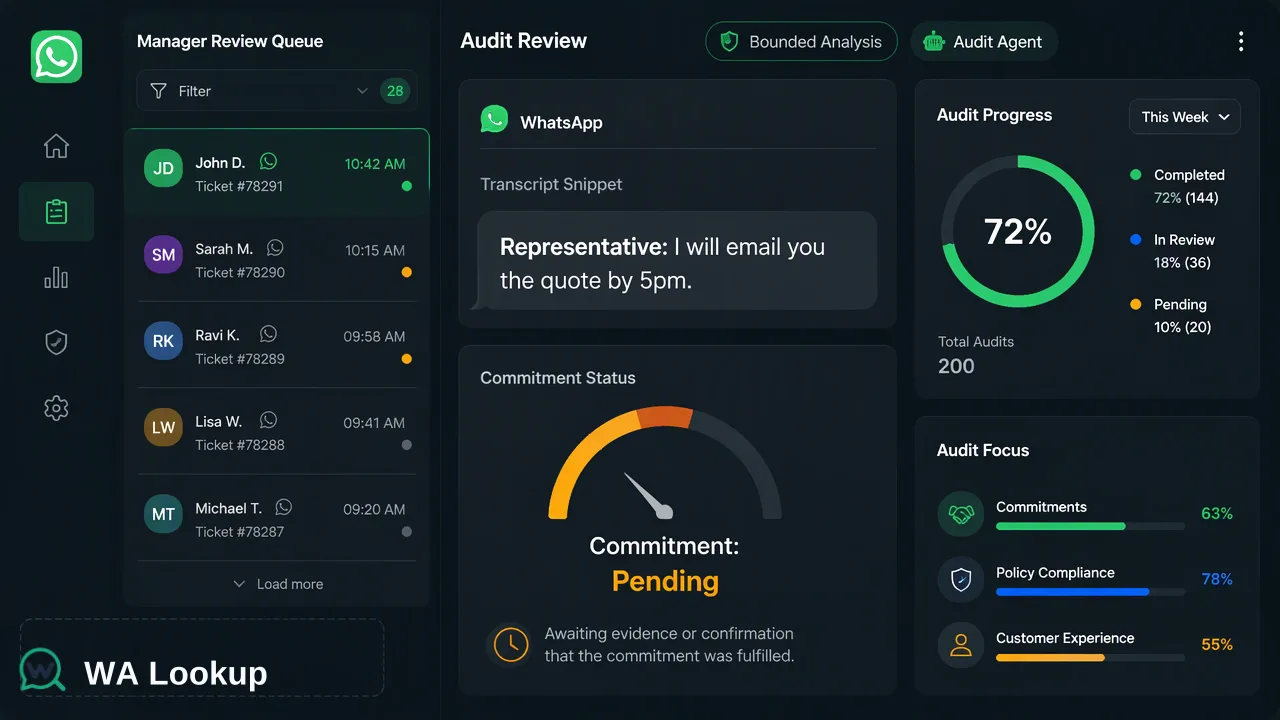
Implement a structured WhatsApp conversation audit workflow to identify inbox drift, surface unfulfilled customer commitments through bounded audit agents, and route recovery tasks to a manager review queue.
A WhatsApp conversation audit workflow helps support and operations teams detect unfulfilled customer commitments before or right after a ticket is marked as resolved. By deploying bounded audit agents to inspect recent message history against explicit business criteria, organizations can identify missing quotes, forgotten callbacks, and unanswered questions without manually reviewing every transcript. Routing flagged dialogues into a dedicated manager review queue separates analytical evaluation from customer-facing execution, creating an orderly path to recover service gaps while protecting communication standards.
The Operational Risk of Inbox Drift in Customer Support
Customer support across messaging channels often moves at high velocity. In high-volume operations, support representatives handle concurrent threads, switch between third-party software tools, and manage complex customer inquiries in real time. This operational intensity frequently creates a failure pattern known as inbox drift.
Inbox drift occurs when a customer support conversation is marked as resolved or closed before all commitments made by the representative have actually been completed. Examples include:
- A representative promises to email an itemized price quotation within two hours but closes the ticket after sending a generic closing salutation.
- An agent assures the customer that a technical specialist will review an error log, yet fails to generate the corresponding internal escalation ticket.
- A customer asks two distinct questions, but the support agent answers only the first question before resolving the session.
When conversations conclude with unfulfilled promises, customer satisfaction drops, repeat contacts surge, and operational friction increases. Manual oversight across thousands of weekly conversations is physically impractical for support managers, making systematic audit workflows essential for identifying service gaps before they drive customer attrition.
Why Keyword-Based Rules Fail to Detect Broken Commitments
Traditional quality assurance in customer service relies heavily on keyword matching, regex rules, or basic phrase searches. While keyword filters can identify obvious triggers, such as profanity or specific billing terms, they consistently fail when tasked with evaluating conversational completeness.
Context-dependent commitments cannot be understood through isolated words. A rule that searches for the word "quote" cannot determine whether the representative actually provided the pricing document, asked a clarifying question, or promised to deliver the document later. Similarly, detecting phrases like "I will follow up" flags that a promise was made, but cannot determine whether the follow-up occurred in a subsequent message.
| Detection Method | Context Awareness | False Positive Rate | Operational Limitation |
|---|---|---|---|
| Keyword Matching | Low | High | Flags specific words without checking resolution state |
| Regex String Filters | Low | Moderate | Unable to parse conversational sequence or intent |
| Bounded Audit Agents | High | Low | Evaluates promise creation against subsequent fulfillment |
Because conversational failures depend on sequence, context, and external tool actions, teams require audit mechanisms that evaluate the relationship between statements across the entire message exchange.
Implementing Bounded Audit Agents for Transcript Analysis
To overcome the limitations of keyword matching, organizations can deploy bounded automated audit agents. A bounded audit agent is an automated analytical process designed to evaluate chat transcripts against strict, predefined business rules rather than operating with open-ended autonomy.
Designing an effective audit agent requires clear behavioral constraints:
- Defined Business Criteria: The agent must evaluate transcripts against explicit questions, such as: "Did the customer request pricing?", "Did the agent promise to deliver a quote?", and "Does the transcript contain the delivery of that quote before closure?"
- Read-Only Operation: The audit agent must never have access to customer-facing communication channels. It processes stored message history asynchronously or at ticket-closure triggers, outputting structured evaluation metadata only.
- Separation of Reasoning from Execution: The agent's task is strictly analytical. It assesses whether an obligation was met and documents its reasoning.
By separating analytical deduction from external action, support teams avoid unintended automated messaging while capturing objective records of unresolved service obligations.
Structuring an Effective Manager Review Queue
Detecting an unfulfilled commitment is only useful if operations teams have a practical mechanism to act on the finding. Reopening every flagged ticket directly into an agent's active inbox risks confusing customers and overwhelming staff. Instead, organizations route audit outputs into a dedicated manager review queue.
A structured review queue presents flagged conversations with context:
- Transcript Snippet: Highlights the specific exchange where the representative made a commitment.
- Identified Missing Action: Details the missing artifact, such as an unsent estimate or an unanswered product query.
- Audit Confidence and Rationale: Explains why the audit agent determined the action was unfulfilled.
- Recommended Recovery Path: Suggests next steps, such as assigning a senior representative to send the requested documentation.
This review queue allows supervisors to verify the agent's findings in seconds. If the supervisor confirms an unfulfilled commitment, they can assign an appropriate representative to reach out and deliver the promised information. This process maintains accountability, supports coaching opportunities, and systematically closes service gaps.
Channel Hygiene and Account Presence in Recovery Outreach
When managers confirm that customer outreach is necessary to fulfill an overlooked promise, maintaining channel hygiene is an important technical step. Before initiating outbound follow-ups on messaging platforms, teams should ensure the recipient's phone number adheres to international standards and represents an accessible platform account.
Numbers formatted in the standard ITU-T Recommendation E.164 format ensure consistent routing across telecommunication platforms. Furthermore, operational teams can query registration signals through dedicated verification APIs like WA Lookup. Submitting an E.164 identifier to the synchronous verification endpoint (POST /api/v1/check with service_type set to ws) returns an account-presence signal indicating whether the phone number is currently registered on WhatsApp.
Checking account presence provides several operational benefits:
- Confirms platform reachability at check time before customer recovery messages are dispatched.
- Informs support routing by identifying whether outreach should proceed via WhatsApp or shift to an alternative verified channel, such as email.
- Supports compliance with the WhatsApp Business Messaging Policy, which requires prior opt-in permission before sending business communications, while respecting data minimization principles outlined in GDPR Article 5 (Regulation (EU) 2016/679).
FAQ
How can teams detect unfulfilled promises in WhatsApp chats without manual review?
Teams can detect unfulfilled commitments by running automated audit agents across closed or pending chat transcripts. Rather than requiring managers to read every message thread, an audit agent evaluates the dialogue against structured criteria—such as checking whether a promised quote file was actually attached or whether a promised callback time was recorded in the ticketing system. When a gap is identified, the agent creates an entry in a manager review queue for human confirmation.
What is the operational difference between keyword tracking and audit agents?
Keyword tracking relies on static string matching, which flags specific terms like "quote" or "tomorrow" regardless of conversational context. Bounded audit agents evaluate conversational sequence and intent, verifying whether an explicit commitment made earlier in the thread was satisfied by subsequent interactions before the dialogue concluded.
How can organizations prevent audit agents from accidentally messaging customers?
Organizations must maintain strict separation between the audit agent's analytical reasoning and customer-facing messaging systems. The audit agent should operate in a read-only environment where its sole output is structured data—such as risk flags, summaries, and audit logs sent directly to an internal review queue.
What role does phone number verification play in service recovery workflows?
When teams prepare follow-up recovery messages for flagged accounts, verifying destination numbers helps maintain operational data hygiene. Checking platform account presence through a synchronous lookup service confirms whether the customer's phone number remains registered on the messaging network at check time.
Learn More
Choose the product information that fits the next step in your workflow.