
WhatsApp Number Format: Writing International Numbers Correctly
Learn the plus sign, country code, and local-number rules for clean WhatsApp contact records, with a practical review process before checking registration.
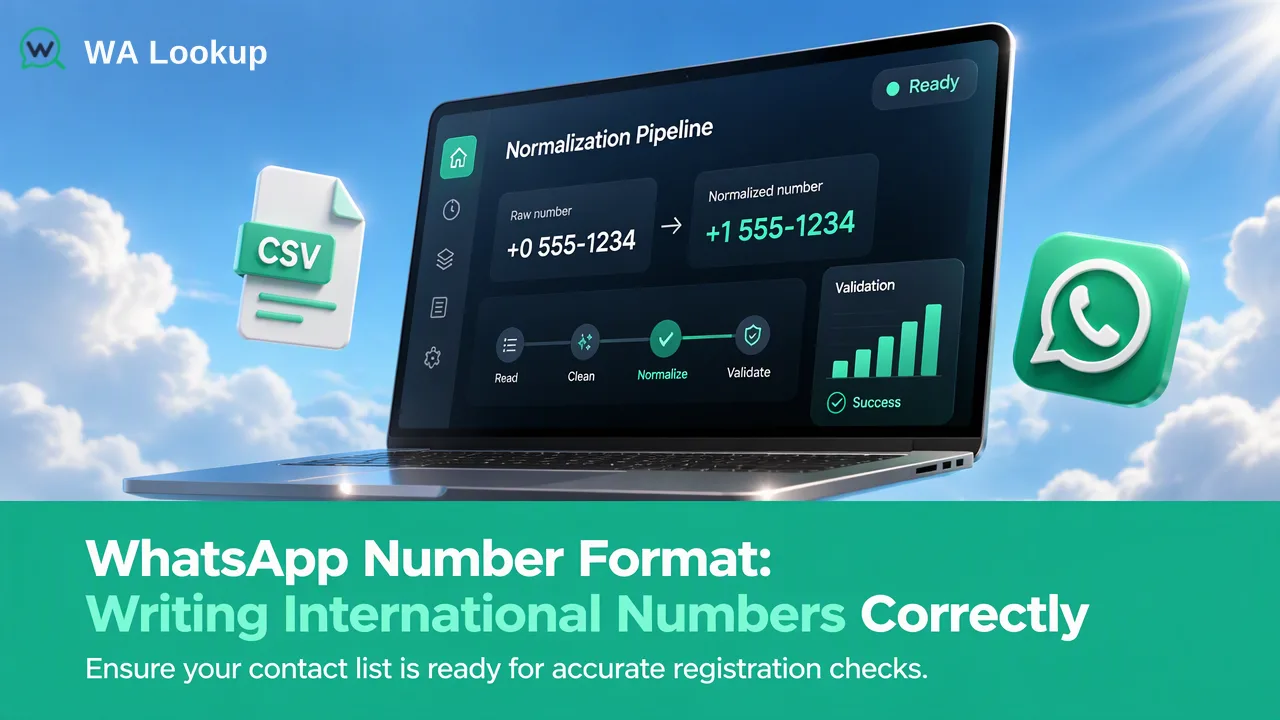
An international WhatsApp number needs a verified country code and national number before a registration check can be interpreted.
The WhatsApp number format for an international contact starts with a plus sign, followed by the country calling code and the national number. The prefix identifies the numbering plan; it does not tell you whether the number currently has a WhatsApp account. Confirm the country and normalize the full number before using a registration check, especially when a list contains local formats from several markets.
What the WhatsApp number format actually contains
A complete international phone number has three practical parts: the plus sign, a country calling code, and the remaining national significant number. The WhatsApp Help Center describes the full international form in these terms. The ITU international numbering plan defines the numbering structure behind country codes. A familiar printed contact may also show spaces, brackets, or hyphens for readability. Those marks are presentation, not evidence that the underlying digits are correct. Store a normalized value separately from the display value so the original entry remains available for review.
A plus sign means that the following digits are expressed with an international country calling code, rather than as a domestic dialing instruction. The first digit alone does not necessarily identify a unique country. For example, +1 is shared across the North American Numbering Plan. A team should use a trusted country-code reference and the contact's supplied country information, rather than inferring a person's location from an arbitrary prefix. The number's calling code is a routing attribute of the number, not a statement about where its holder lives or is traveling.
For a check, the important distinction is between a complete country-coded number and a bare local string. A local number might be meaningful only with an accompanying country field. If that field is missing, appending the team's own country code can silently change which number is checked. Keep the row in a review queue until the country can be established from the source record or directly confirmed by the contact.
Why copied numbers commonly go wrong
The most common error is a missing country code. A spreadsheet column may contain numbers collected from a domestic form, an address book, and an imported CRM. Identical-looking local digits can refer to different international numbers. Assign a country only when the source record supports it. A separate country column should be reviewed for stale defaults, free-text abbreviations, and mismatches with the original phone field before conversion.
A second error is mechanically keeping a domestic dialing prefix when converting to international form. Some numbering plans use a trunk prefix when a number is dialed locally, and that prefix may need different treatment in international form. Rules vary by country, so do not strip every leading zero in a global spreadsheet formula. Use a maintained country-aware numbering library or the relevant national numbering instructions, then inspect samples from each market. The ITU dialing-procedures register is a useful primary reference for country and national prefix rules.
Extra material creates another class of ambiguity: extensions, labels such as office or mobile, two phone numbers in one cell, punctuation copied from a signature, or a dialing prefix such as 00. Do not simply delete every non-digit character and assume the resulting string identifies the intended person. Split multiple values into separate records, preserve an extension as a separate field, and quarantine values that cannot be resolved confidently. A clean representation helps a system address a number; it cannot confirm registration by itself.
A safe normalization pass for contact lists
Start with the source number, source country, record identifier, and collection date. Keep the original phone field untouched. Parse the number using the known country context, then save a second normalized international field. Flag rows where parsing fails, where the country is missing, or where the parsed code conflicts with the recorded country. Those flags should be resolved before checking; a negative check on the wrong international number is misleading.
Review samples from each source system and each country represented in the export. Compare the normalized number with the source record and verify that the same transformation was not applied twice. Deduplicate on the normalized value only after deciding how shared business numbers or duplicate CRM contacts should be represented. A duplicate row is a data-management issue; it should not be used as proof of multiple WhatsApp accounts. Keep the contact's original identifier so any later check result can be joined back without relying on row order.
The WA Lookup how-it-works page explains the product's registration-check workflow. A team can use a realtime check for an individual country-coded number or select a documented list workflow when many reviewed numbers are ready. A completed registration result is an account-presence signal at the time of the check. It does not establish ownership, identity, permission to contact, or delivery. Keep an undetermined or service-error outcome separate from a decided not-registered result.
How to decide whether a formatted number is ready to check
A number is ready when the country context has been verified, conversion produced one unambiguous international value, and the source record can be traced. It is not ready merely because it starts with a plus sign. A mistyped country code, an extra local prefix, or a copied extension can all produce a superficially international-looking string. Record the reason a row was held back, rather than forcing a check result into every CRM cell.
Separate three stages in reporting: format review, registration checking, and contact-policy decisions. Format review asks whether the digits represent the intended international number. A registration check asks whether a WhatsApp account-presence signal was found at check time. The team's consent and messaging policy determine whether outreach is appropriate. Keeping those stages separate prevents a correct format or a positive account-presence signal from being misread as authorization to send messages.
For a larger list, use the WA Lookup registration-check page to choose the relevant check after normalization. Retain the check date and the normalized number alongside the decided result. If the source number is later corrected, review the old result as belonging to the old submitted value; do not silently move it to the corrected contact. That audit trail makes future rechecks meaningful.
FAQ
Does a plus sign prove that a number is on WhatsApp?
No. The plus sign identifies an international number representation. A separate registration check is needed for an account-presence signal, and that signal applies at check time.
Can teams add their own country code to every local number?
Only when the source context confirms that country for each row. A mixed-country list needs row-level context; otherwise an apparently valid conversion may address a different number.
Should teams remove every leading zero during conversion?
No. National numbering rules vary. Use country-aware rules and review ambiguous rows instead of applying a universal spreadsheet deletion.
What should teams keep after a WhatsApp number check?
Keep the original and normalized number, source record identifier, check date, and the distinct decided or undetermined outcome. This supports review when a number or contact record changes.
Learn More
Choose the product information that fits the next step in your workflow.