
WhatsApp Country Codes: Reading the Plus Prefix on a Contact
Understand what +1, +44, and +91 mean, why a country code matters for contact data, and how to prepare country-coded numbers for a check.
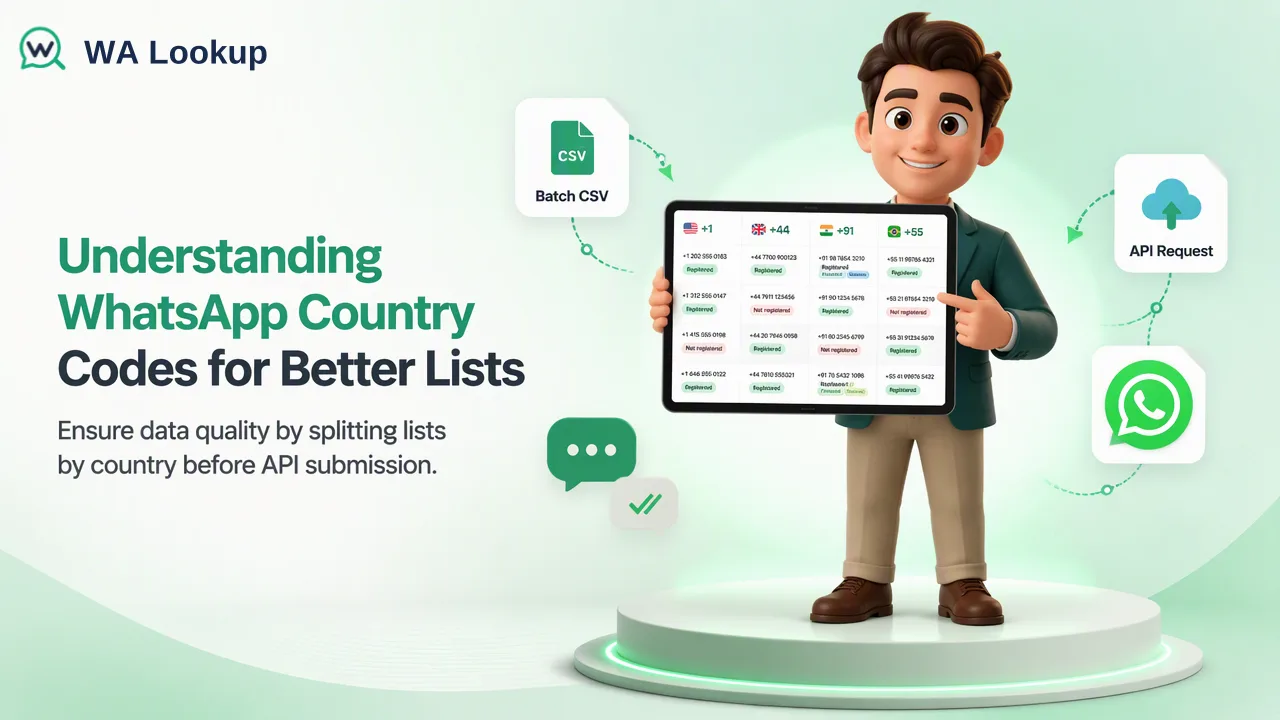
A WhatsApp country code is the telephone calling code in an international number, not proof of the contact's location or account status.
A WhatsApp country code is the calling code after the plus sign in an international phone number. For example, +1 belongs to the North American Numbering Plan, +44 to the United Kingdom, and +91 to India. The prefix helps identify which phone number a check addresses, but it does not establish where a person currently is or whether that number has a WhatsApp account.
What a WhatsApp country code tells you
Country calling codes are part of the international public telephone numbering plan. The ITU E.164 recommendation defines how international numbers are structured, and the ITU assigned-code register lists the codes. WhatsApp's international number guidance asks for the plus sign and full international number. The prefix is therefore useful as an addressing component. It is not a location tracker. A person can move, use a number assigned elsewhere, or retain a number after changing residence.
Some prefixes are shared. +1 covers a numbering plan with more than one country or territory. It is consequently inaccurate to read every +1 number as a United States resident. +44 and +91 identify different calling-code areas, but neither prefix establishes that the current user is physically there. Treat the code as part of the number, and use a separately verified country field for business decisions that depend on geography.
The digits after the country code are also necessary. A prefix alone does not identify a contact, and a local number without its country context may be ambiguous. When a CRM stores a bare local string, find the country from the original form, contract, or confirmed contact record before creating an international value. Do not borrow a default country from the person operating the spreadsheet.
Why the plus prefix matters in a contact list
International lists are often assembled from several systems. One form may save +44 with the national number; another may keep a domestic dialing zero; a third may save only local digits. If these strings are compared as raw text, one person can appear as several contacts, or two different international numbers can appear deceptively similar. Normalize the phone field while retaining the original, and keep a stable contact ID for later reconciliation.
The plus sign is a marker for the international representation, not a character to append to every unreviewed string. A wrong country code can still produce a clean-looking value. Similarly, removing all leading zeros without country-aware rules may alter a valid national number. The ITU dialing-procedures data provides primary context for national and international prefixes. When a source country is uncertain, hold the row for review instead of making a universal conversion.
A quality pass should count missing country fields, conflicting country and prefix fields, duplicate normalized values, and numbers containing extensions or multiple values. These are data-quality categories, not WhatsApp registration outcomes. Fix them before the check so an apparently negative result is not really a check of the wrong number. Preserve the source row and conversion date so a correction can be traced.
How country-coded numbers fit WA Lookup checks
WA Lookup's realtime registration check uses a submitted country-coded number to return an account-presence signal. The dashboard supports individual checks and a pasted Realtime Batch Check for up to 500 numbers; the REST API also supports a synchronous multi request for up to 100 numbers. These realtime routes return results in the initiating response. Choose the route based on the number of reviewed records and the team's workflow, not on an assumption that the country code itself answers the registration question.
For much larger prepared lists, WA Lookup offers asynchronous TXT or CSV file tasks, subject to the selected product limits in the API documentation. The task returns an ID first and a downloadable result.csv after processing. Bulk files must have one country and country-coded phone numbers. If 10% or more of the numbers belong to other countries, precheck rejects the file. Split a multi-country master list into country-specific work groups; keep a separate mapping to the original CRM IDs so the results can be joined back. The current API documentation is the source for workflow details.
The country field used for a bulk task should reflect the submitted phone numbers, not merely the office that exported the list. A cross-border sales team might own one spreadsheet containing many calling codes. Preparing separate work groups is a file-quality decision and avoids treating rejected submissions as results. Do not turn a row that was never checked into registered=false.
What the prefix and check result cannot establish
A calling code identifies a numbering-plan area. A completed registration result describes WhatsApp account presence at check time. Neither establishes the person's current location, identity, ownership of the number, consent to receive messages, or a future delivery or response. Keep those questions in separate CRM fields and operational checks. For example, a valid +91-formatted value can still be entered for the wrong contact, and a correctly addressed number can lack a decided registration result.
Store the normalized number, the source country evidence, the selected check, and the date of a completed result. Distinguish decided registered, decided not registered, and unresolved outcomes. An undetermined or service-error response is not a decided negative result. If a source record changes its country or phone value, examine the old result against the exact previously submitted number rather than copying it to the new value.
The most useful rule for teams is simple: interpret the prefix as input context, then interpret the check as a time-specific signal. This keeps number formatting, registration review, and contact-policy decisions from collapsing into one vague verified label. A well-maintained contact list allows each decision to be revisited when the underlying number changes.
FAQ
Does +1 always mean that a contact is in the United States?
No. +1 serves the North American Numbering Plan, and a calling code does not establish a person's present location.
Can teams use a WhatsApp country code to tell whether an account exists?
No. The code is part of the phone number. A separate completed registration check supplies an account-presence signal at check time.
How should teams handle a list with several calling codes?
Normalize each number using verified country context. For an asynchronous bulk file task, organize country-specific files and retain a mapping to original contact IDs.
What if a number has no trustworthy country context?
Hold the row for source review or direct confirmation. Guessing a prefix can cause a check to address a different number and produce a misleading contact classification.
Learn More
Choose the product information that fits the next step in your workflow.