
Product guidance
Navigating WhatsApp Business Verification: Strategies for Maintaining Operational Continuity
Explore operational alternatives during WhatsApp Business verification delays. Use synchronous checks to maintain contact data hygiene and routing.
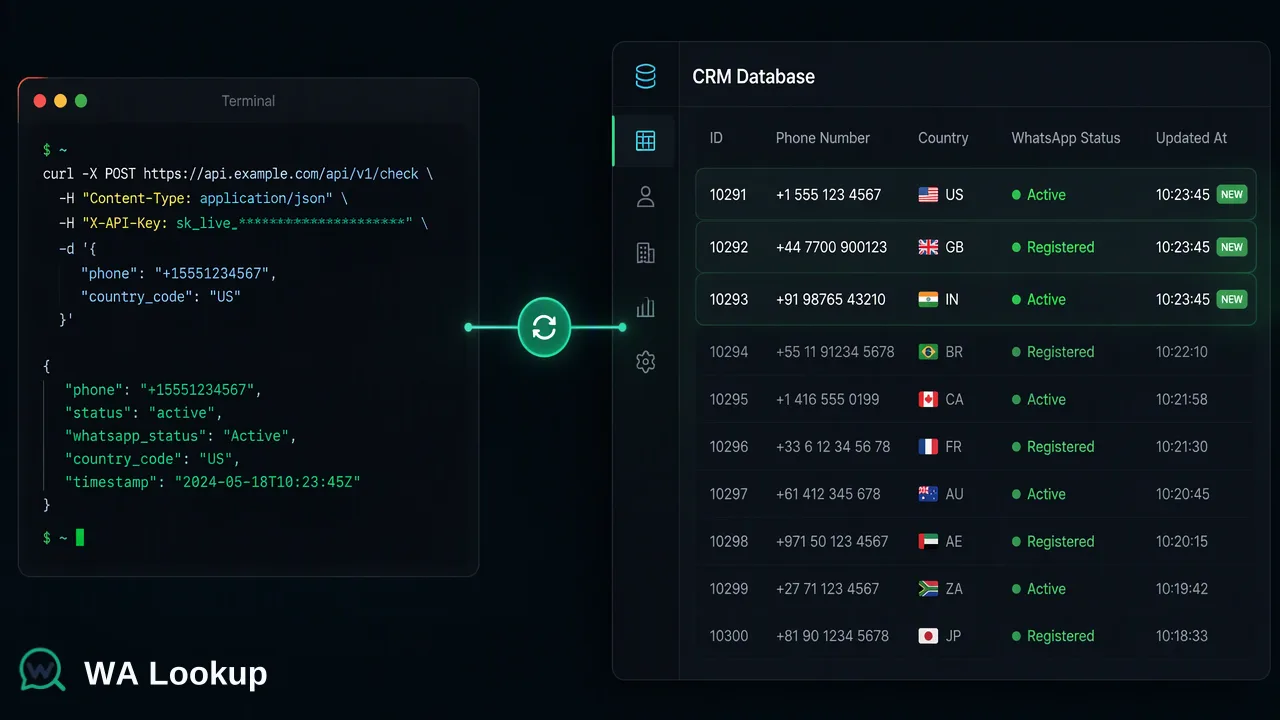
Learn how operational teams navigate WhatsApp Business verification bottlenecks by integrating real-time account registration signals and synchronous API workflows into contact routing.
Organizations facing WhatsApp Business verification delays can maintain operational continuity by integrating real-time platform registration signals into contact onboarding and routing infrastructure. By deploying synchronous checks that confirm whether a phone number currently exists on WhatsApp, technical teams keep customer databases organized, filter non-registered numbers, and separate testing configurations from production-grade workflows without waiting for official verification queues to clear.
The Impact of Verification Bottlenecks on Messaging Operations
Formal business verification on enterprise messaging networks often introduces administrative queues that stall customer onboarding and disrupt digital communication launches. When teams wait weeks for business entity reviews, direct outreach campaigns pause, and incoming user contacts accumulate without dynamic routing rules. Organizations that lack pre-verification data validation often face operational drift. Unchecked contact databases collect invalid or unreachable entries, complicating pipeline reporting and inflating infrastructure load. To prevent verification bottlenecks from halting business operations, engineering and sales-operations teams implement alternative data validation patterns that evaluate contact reachability at the point of ingestion.
Maintaining Connectivity with Real-Time Registration Signals
A practical alternative to waiting passively for verification clearance is verifying whether user phone numbers are registered on WhatsApp before scheduling messages. WA Lookup provides synchronous REST API endpoints that evaluate submitted phone numbers against live WhatsApp account signals. When a phone number formatted in E.164 standard is submitted via POST /api/v1/check using the X-API-Key authentication header, the service returns immediate data regarding platform presence. The public data envelope provides the queried identifier, the selected service type, and a boolean registered signal. This synchronous signal gives backend routing systems real-time context to direct contacts toward WhatsApp pipelines or divert them toward fallback communication channels like SMS or email.
Evaluating Check Options for Account Context
Different operational workflows require varying depths of account data. WA Lookup structures registration queries into three specific check types via the service_type parameter:
| Service Type | Scope & Returned Account Signals | Key Operational Role |
|---|---|---|
ws |
Basic account presence confirmation (registered). |
Rapid contact filtering and channel eligibility routing. |
ws_avatar |
Platform presence plus profile photo indicators (avatar, avatar_url). |
Profile enrichment and contact record completeness. |
ws_business |
Platform presence plus business account status (business). |
B2B lead segmentation and enterprise routing logic. |
In B2B environments, utilizing ws_business informs systems whether a recipient utilizes an enterprise profile, helping teams tailor communication workflows. If a check cannot be decided, the API returns a non-zero business code rather than an ambiguous completed state, ensuring programmatic systems handle unconfirmed records cleanly. |
Best Practices for Pre-Verification Data Hygiene
Maintaining high data hygiene standards during the pre-verification stage ensures that when official permissions activate, messaging lists are already structured and purged of dead entries. Technical teams apply several standard practices:
- Standardize on Ingestion: Enforce E.164 formatting on web forms and CRM entry points prior to running any validation logic. 2. Synchronous Contact Gateways: Execute single-number lookups during account creation or intake form submission to confirm account presence immediately. 3. Batch List Hygiene: For legacy databases, use the synchronous batch endpoint to evaluate up to 100 identifiers per HTTP request, returning consolidated account signals in a single operation. 4. Appropriate Signal Interpretation: Treat a confirmed registration signal solely as technical reachability at check time.
Architecting for Operational Continuity
Decoupling verification testing from core messaging infrastructure prevents external platform delays from blocking software release cycles. In development and staging environments, engineering teams can validate routing algorithms and workflow triggers against live registration endpoints without sending test messages across unverified numbers. Because WA Lookup delivers checks synchronously within the same HTTP connection, application architectures avoid the latency, polling intervals, and webhook management required by asynchronous queue processors. Furthermore, development environments leveraging AI tools can connect to the official MCP server over Streamable HTTP/JSON-RPC, using existing credentials to inspect product availability and check single or batch identifiers directly within development assistants. Managing requests under documented concurrency and timeout controls supports stable performance across all testing and production tiers.
FAQ
How do operational teams maintain workflow continuity while awaiting formal verification?
Teams maintain momentum by validating submitted phone numbers against current platform-registration signals before loading them into messaging pipelines. Confirming that a record corresponds to an existing WhatsApp account allows routing engines to segment reachable contacts from unsupported numbers, keeping data clean while administrative approvals remain pending.
Why is a synchronous API model preferred for routing workflows?
A synchronous API model returns verification signals directly within the initiating HTTP response. This design eliminates complex asynchronous mechanisms such as background polling queues, database worker threads, and webhook receiver infrastructure, enabling immediate decisions during lead intake or contact-form processing.
What does a positive platform registration check indicate?
Learn More
Choose the product information that fits the next step in your workflow.