
Product guidance
Building Compliant WhatsApp Automation: Task-Specific Agents vs. General AI
Learn how to navigate WhatsApp business automation compliance by shifting from general AI to task-specific bots using real-time registration signals.
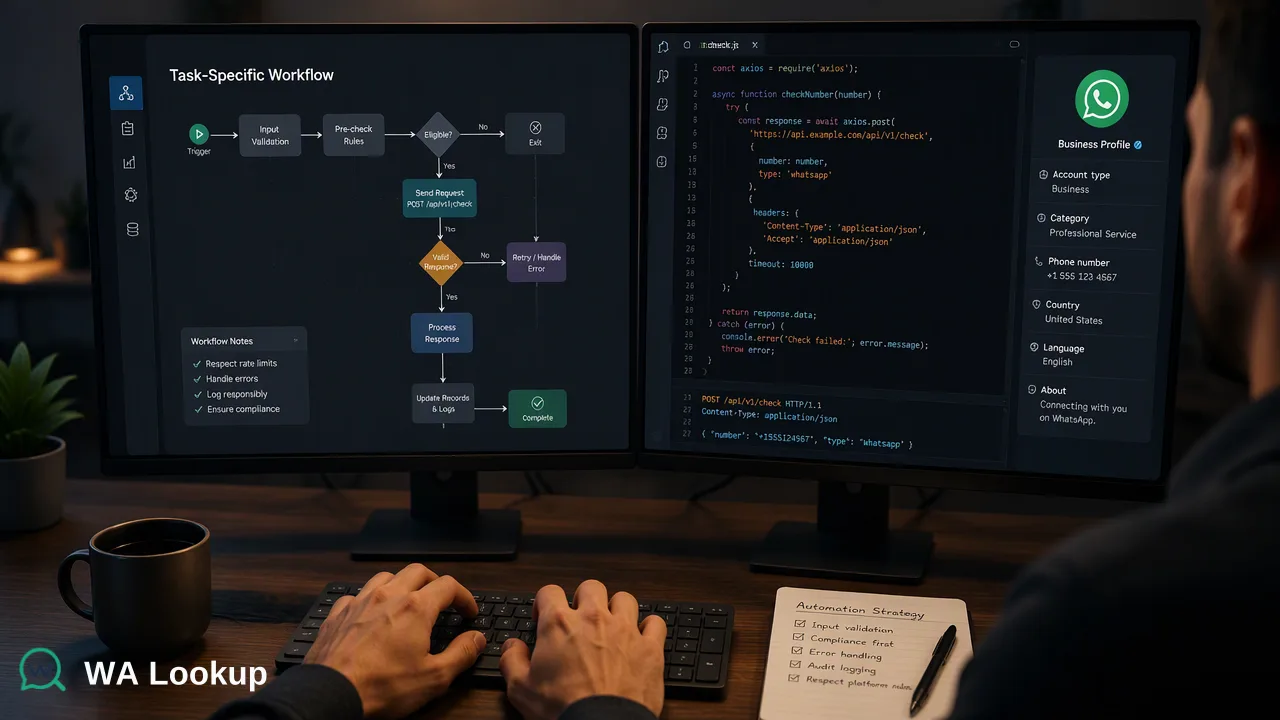
Navigate the 2026 policy updates by shifting from general-purpose AI to task-specific business automation, supported by real-time registration checks.
To remain compliant under 2026 policy updates, organizations must replace general-purpose AI assistants with task-specific automation. Compliant bots focus on narrow, defined functions like order tracking or scheduling rather than acting as open-ended conversational agents. By integrating real-time registration checks, teams ensure their automated workflows interact only with valid, reachable accounts. This approach maintains operational efficiency while adhering to platform standards for business communication.
The Shift in WhatsApp Automation Policy
Meta's 2026 policy updates introduce a clear distinction in how automated systems can operate on the platform. These updates prohibit general-purpose AI assistants while explicitly permitting task-oriented business automation. Organizations that previously relied on open-ended conversational models must restructure their workflows to align with these new boundaries. The policy shift targets the primary functionality of automated agents, ensuring that the platform remains a space for defined business interactions rather than unrestricted AI experimentation. Teams evaluating their current infrastructure must audit their automated responses to confirm they serve a specific, ancillary business purpose. Adapting to this landscape requires a strategic move toward structured, predictable workflows that support customer needs without crossing into prohibited general AI territory.
Defining Compliant Automation: Task-Specific vs. General AI
Understanding the technical and operational differences between task-specific bots and general AI is essential for maintaining WhatsApp business automation compliance. Task-specific bots are considered ancillary and compliant when they perform defined business functions. These systems operate within strict parameters, handling predictable requests such as automated order status notifications, appointment scheduling, or basic account inquiries. Their responses are constrained to the specific workflow they are designed to support. Conversely, primary functionality AI that acts as an open-ended assistant poses a compliance risk. These systems attempt to handle any user query, generating dynamic responses outside of a predefined business scope. When an automated agent acts as a general conversational partner rather than a specialized tool, it violates the updated policy constraints. Organizations must design their automation architecture so that the bot's capabilities are explicitly tied to a narrow business objective. Structuring automation as a business tool rather than an open-ended assistant helps teams maintain compliance while still delivering efficient automated service.
Operationalizing Compliance with Real-Time Signals
Building compliant workflows requires accurate data inputs to ensure automated systems interact only with accounts registered on the platform. Real-time registration checks confirm platform reachability at the moment of contact. By verifying that a submitted phone number is currently registered on the platform before initiating an automated sequence, organizations can optimize their communication infrastructure. WA Lookup provides a synchronous REST API to check WhatsApp registration status and account signals for a submitted phone number. Teams can integrate the POST /api/v1/check endpoint into their automation pipelines. The API requires an X-API-Key header and a JSON payload containing the service_type (such as ws, ws_avatar, or ws_business) and the identifier formatted in the E.164 standard. The synchronous response returns an outer envelope containing code, msg, and data. If a check cannot be decided, the API returns a non-zero business code and no completed result object, ensuring workflows do not act on undetermined data. For higher volume workflows, a synchronous batch endpoint accepts up to 100 identifiers in one request and returns the whole batch or fails as a whole. Registration signals help optimize budgets and improve operational efficiency by validating contact lists before outreach. By filtering out unreachable numbers, teams can focus their automated task-specific bots on valid accounts, supporting better resource allocation and cleaner workflow inputs.
Best Practices for Sustainable Automation
Maintaining long-term compliance requires a combination of strict workflow boundaries and appropriate human oversight. Teams should implement the following practices to ensure their automated systems remain aligned with platform policies:
Define Narrow Scopes: Restrict the automated agent's capabilities to specific business functions. If a user query falls outside this scope, the system should not attempt to generate a general AI response. Structure automation as a business tool rather than an open-ended assistant.
Implement Human-in-the-Loop Handoffs: Maintain human-in-the-loop handoffs for complex or sensitive interactions. When a task-specific bot encounters a request it cannot resolve within its defined parameters, it should seamlessly route the conversation to a human agent. This prevents the automation from attempting to act as a general assistant and ensures complex issues receive appropriate attention.
Validate Inputs Before Execution: Use real-time registration checks as a foundational step in the automation pipeline. This check provides the necessary context to determine if an automated message can be delivered, which informs the subsequent routing logic.
Monitor Workflow Performance: Regularly review the interactions handled by task-specific bots to ensure they are not drifting into open-ended conversations. Adjust the system's routing logic to reinforce the distinction between automated business tasks and human-led support.
By combining precise API checks with strict operational boundaries, organizations can build sustainable, compliant automation infrastructure.
FAQ
What is the difference between task-specific bots and general AI?
Task-specific bots are designed to perform a single, defined business function, such as providing order status updates or scheduling appointments. They operate within strict parameters and are considered compliant ancillary tools. General AI acts as an open-ended conversational assistant capable of handling unrestricted topics, which poses a compliance risk under the 2026 policy updates.
Why are real-time registration checks important for compliance?
Real-time registration checks confirm platform reachability at the moment of contact. By verifying that a number is registered before initiating an automated workflow, teams ensure their task-specific bots interact only with valid accounts. This helps optimize operational efficiency and supports compliant communication practices by preventing automated systems from attempting to message unreachable destinations.