
Product guidance
What Is E.164? The International Phone Number Format Explained
Learn what the E.164 phone number format is, how international numbers are structured, and why technical systems normalize numbers to this global standard.
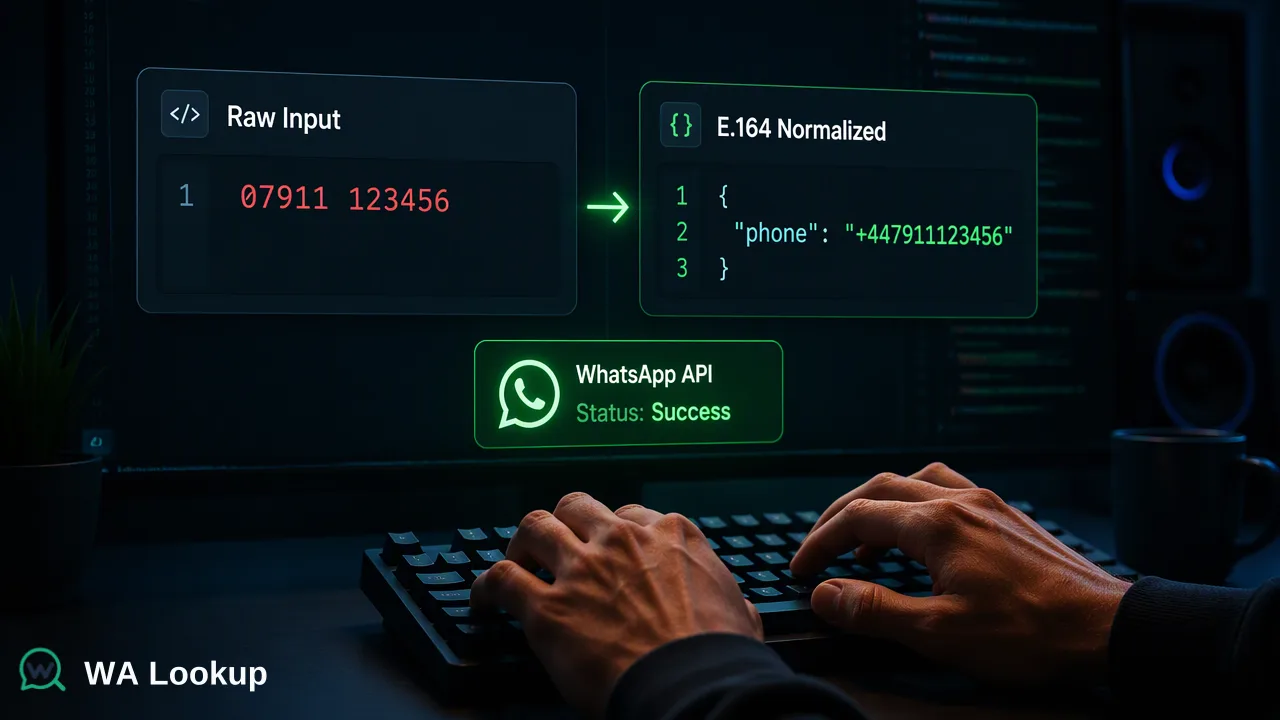
A comprehensive guide to the E.164 international phone number format, detailing its structure, maximum length, dialing normalization, and role in modern communication workflows.
The E.164 phone number format is an international telecommunications standard that establishes a single, globally unique representation for telephone numbers across public switched networks and digital systems. Governed by the International Telecommunication Union (ITU-T), an E.164 number begins with a leading plus sign (+) followed by a country calling code and a national subscriber number, containing no spaces, hyphens, or local access prefixes, and reaching a maximum length of 15 digits.
The Structure and Components of an E.164 Number
To achieve universal interoperability, the E.164 specification defines a strict hierarchical format consisting of three core elements organized into a continuous numerical sequence without formatting spaces, hyphens, or parentheses. First, an E.164 number begins with the international prefix symbol, represented by the plus sign (+). This character indicates that the following digits include an international country code rather than an internal national routing code. Second, the Country Code (CC) directly follows the plus sign. Country codes range between one and three digits, assigned systematically by the ITU-T to geographical territories and specialized telecommunication services. For example, North American Numbering Plan territories use the country code 1, while the United Kingdom uses 44, and Australia uses 61. Third, the National Significant Number (NSN) follows the country code. The NSN consists of any national destination codes, regional area codes, and the final subscriber line number. Combined, the country code and the national significant number may contain at most 15 decimal digits. For example, consider a standard local United States telephone number written regionally as (555) 123-4567. When structured under the E.164 specification, this record strips punctuation and prepends the country calling code, becoming +15551234567.
E.164 vs. Regional and Local Dialing Conventions
Everyday domestic telephony relies on local dialing conventions that introduce substantial ambiguity when stored in global databases. In domestic contexts, callers often utilize trunk prefixes or exit codes that depend strictly on the caller's immediate physical location. In many European and Asian jurisdictions, domestic calls require a leading trunk prefix '0' to signal that the call remains within national borders. For instance, a mobile number within the United Kingdom might be dialed domestically as 07911 123456. In an international context, however, that leading zero must be removed; the equivalent E.164 representation is +447911123456. Retaining the trunk zero in an international request causes routing errors because the downstream exchange attempts to interpret the digit as part of the country's national area allocation. Similarly, international outbound calls placed from domestic landlines traditionally require an international call prefix, such as '00' in Europe or '011' in North America. These exit codes are non-standard across borders. E.164 replaces every regional exit code with the universal '+' character, creating a uniform, machine-readable standard regardless of the originating telecommunications provider.
Why Verification Systems and APIs Standardize on E.164
For data engineers, CRM administrators, and security teams managing customer directories, normalizing records into E.164 is essential for database integrity and third-party software integration. Without a strict standard, databases frequently accumulate identical phone numbers stored under disparate permutations, such as +44 7911 123456, 07911123456, and 00447911123456, leading to fragmented customer profiles and duplicate messaging workflows. Standardizing on E.164 provides a deterministic primary key for identity mapping, user management, and automated telecommunication routing. Furthermore, specialized programmatic platforms require E.164 input to evaluate phone-level signals accurately. For instance, WA Lookup requires numbers to be submitted in E.164 format when checking account signals through its synchronous REST API endpoints. Enforcing E.164 normalization at the API ingress ensures that lookup services route queries directly to the correct global telecommunications namespace.
Technical Considerations for Phone Number Normalization
Implementing automated E.164 normalization requires parsing rules that account for regional numbering anomalies. Development pipelines typically ingest user-entered phone strings, validate them against the ITU-T allocation tables, and reformat them before database persistence. A robust normalization workflow generally incorporates three stages:
- Punctuation Stripping: Removing non-numeric visual separators such as spaces, hyphens, periods, and parentheses, while retaining any leading plus sign. 2. Prefix Resolution: Identifying domestic trunk prefixes (such as leading zeros) or carrier access codes based on the inferred or explicitly selected country code, and stripping them in accordance with national dialing rules. 3. Validation and Serialization: Verifying that the resulting numeric string complies with the country code's designated length rules and falls within the 15-digit maximum ceiling defined by the E.164 standard. By executing this normalization early in data ingestion pipelines, organizations ensure that downstream API requests—whether querying messaging reachability, carrier data, or platform registration—operate on consistent, canonical phone records.
FAQ
What is the maximum digit length permitted by the E.164 standard?
Under the ITU-T E.164 recommendation, the entire telephone number—combining the country calling code, national destination code or area code, and individual subscriber number—cannot exceed 15 digits. The leading plus sign is a formatting character and does not count toward this 15-digit limit.
Why do digital verification APIs require E.164 formatting?
Verification endpoints require E.164 because international lookups require unambiguous geographical and routing definitions. Normalizing records to E.164 ensures that systems process every submitted identifier against telecommunications platforms without misinterpreting local trunk prefixes, leading zeros, or regional punctuation.
How does formatting to E.164 relate to carrier or platform registration?
E.164 formatting normalizes a string into a standardized telecommunications structure. While formatting confirms that an input conforms to global layout rules, downstream platform checks or carrier lookups evaluate whether that normalized number is registered or reachable on a specific network at check time.
Learn More
Choose the product information that fits the next step in your workflow.