
Product guidance
What Silent Platform Registration Checks Mean
Learn how a silent platform registration check provides a synchronous reachability and deliverability signal without notifying the account owner.
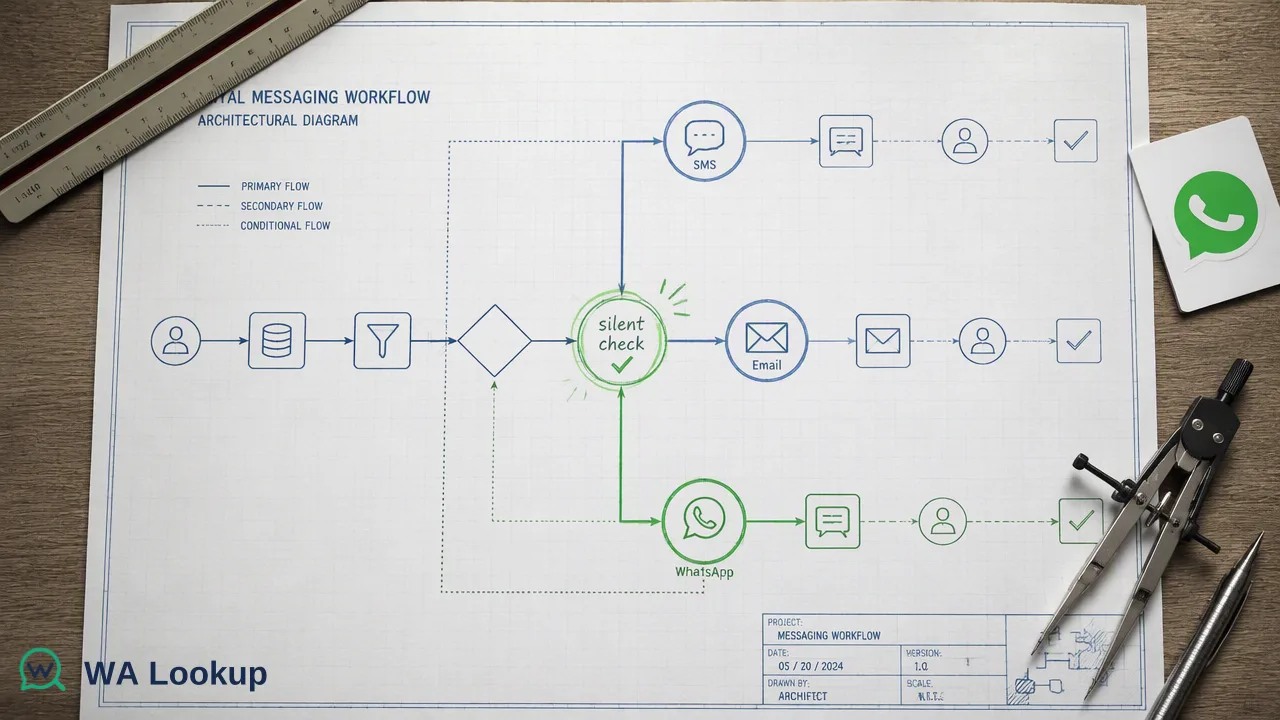
A comprehensive guide to silent platform registration checks, explaining how they provide synchronous reachability signals without notifying account owners.
A silent platform registration check is a verification method that determines whether a submitted phone number is currently registered on a specific messaging platform without alerting the account owner, sending a message, or requiring user interaction. Organizations use these checks to confirm that a number is active on a target platform before initiating outreach, helping teams segment audiences and plan communication workflows based on platform account presence.
Defining Silent Platform Registration Checks
A silent platform registration check evaluates whether a specific phone number is associated with an account on a messaging platform. The term "silent" indicates the operational method: the check queries the platform's directory directly without interacting with the end user's device. The system does not send SMS messages, trigger application push notifications, or prompt the user for authentication. To initiate a check, organizations submit a phone number in the standard E.164 format. The verification platform processes this input and returns a synchronous response. Because the workflow is synchronous, the result is delivered in the initiating HTTP response rather than through asynchronous callbacks or polling mechanisms. This immediate feedback loop allows applications to make real-time routing decisions based on the account-presence signal.
How Silent Checks Differ from Network Authentication
Organizations often evaluate both platform-level checks and network-level checks when designing communication workflows. While both operate without user friction, they query entirely different infrastructure layers. Silent Network Authentication (SNA) typically involves carrier-level signaling. It communicates with mobile network operators to verify that a specific SIM card or device is currently active on the cellular network. SNA is heavily tied to the physical telecom infrastructure. In contrast, a silent platform registration check focuses strictly on application-layer account presence. It verifies whether the number is registered with a specific service, such as WhatsApp. A user might possess a valid carrier number that is not registered on WhatsApp, or conversely, they might register a VoIP number on WhatsApp that has no presence on a traditional cellular network.
| Feature | Platform Registration Check | Silent Network Authentication |
|---|---|---|
| Target Infrastructure | Messaging application (e.g., WhatsApp) | Mobile network operator (Carrier) |
| Primary Signal | Application account presence | Cellular network presence |
| Number Types Supported | Mobile, Landline, VoIP (if registered) | Primarily Mobile (SIM-based) |
| Workflow Integration | Omnichannel routing, audience segmentation | Carrier-level device verification |
Understanding the Reachability Signal
A registration signal confirms that the submitted E.164 number is currently associated with an account on the target platform, meaning the platform's infrastructure is capable of receiving messages directed to that identifier. It serves as a foundational workflow input. By confirming reachability, the signal helps teams allocate resources efficiently, ensuring that platform-specific messages are only generated for numbers that actually possess the corresponding application account.
Operational Use Cases for Registration Signals
Organizations integrate silent platform registration checks into various operational workflows to support data hygiene and communication planning.
Audience Segmentation
Marketing and sales operations teams use registration signals to segment contact lists based on platform availability. By identifying which contacts are reachable on WhatsApp, teams can tailor their outreach strategies, directing rich-media campaigns to platform users while reserving standard SMS for contacts without application accounts.
Omnichannel Routing
Customer support platforms utilize synchronous checks to inform message routing. When a customer initiates a support ticket, the system can instantly check the provided phone number. If the number returns a positive platform-registration signal, the system can route follow-up notifications through the messaging app; if not, it defaults to email or SMS.
CRM Data Hygiene
Database administrators periodically audit legacy CRM records using batch checks. This process helps organizations maintain accurate records of which contacts still maintain active platform registrations, supporting better analytics and more accurate campaign planning.
API Integration and Synchronous Workflows
Technical teams implement silent platform registration checks using a synchronous REST API. The documented request contract utilizes the POST /api/v1/check endpoint. Requests require an X-API-Key header for authentication and a Content-Type: application/json header. The JSON payload must include two primary fields: service_type, which dictates the specific product being queried, and identifier, which contains the target phone number in E.164 format. The API architecture is strictly synchronous. Every check endpoint returns its result in the initiating HTTP response. The outer response envelope for a completed check consists of code, msg, and data. If a check cannot be decided by the system, the API returns a non-zero business code rather than a completed result object. For higher-volume operations, the platform provides a synchronous batch endpoint. This endpoint accepts up to 100 identifiers in a single request. It processes the entire batch synchronously and returns the complete set of results in one response, avoiding the complexity of task-submission, polling, or callback workflows.
WhatsApp-Specific Check Types
When querying WhatsApp registration status, organizations can select from three distinct check types using the service_type parameter. All three products utilize the same synchronous endpoints, with the service_type controlling which fields are returned in the public data object.
Standard Registration Check (ws)
The ws service type provides the baseline platform-registration signal. The returned data object contains the service_type, the identifier, and a boolean registered field indicating account presence.
Avatar Enrichment Check (ws_avatar)
The ws_avatar service type includes the baseline registration signal and adds profile enrichment data. The response includes an avatar boolean and an avatar_url string. The URL field provides the location of the profile image, though it may return as an empty string depending on the account's configuration.
Business Profile Check (ws_business)
The ws_business service type checks standard registration and evaluates whether the account utilizes the WhatsApp Business application. The response appends a business boolean to the standard data object, helping teams segment standard users from business accounts.
Model Context Protocol (MCP) Integration
For teams utilizing AI-driven workflows, silent platform registration checks can be executed directly through AI assistants. WA Lookup provides an official Model Context Protocol (MCP) Server accessible at the website's /mcp path over Streamable HTTP / JSON-RPC. This integration allows MCP-compatible AI clients, such as Claude Code, Cursor, and Claude Desktop, to perform real-time checks using the organization's existing API key. The MCP Server shares the exact same products, balance, authentication, concurrency limits, and synchronous result semantics as the standard REST API. The tools exposed to the AI assistant include listing available products, checking a single E.164 number, synchronously checking a small batch of up to 100 numbers, and querying the account balance. Because the MCP calls are real-time and synchronous, they seamlessly integrate into conversational AI workflows without requiring asynchronous task management.
FAQ
What does a silent platform registration check return?
For WhatsApp, the check confirms whether the submitted E.164 phone number is currently associated with a WhatsApp account.
How must phone numbers be formatted for a registration check?
All submitted phone numbers must be formatted according to the E.164 standard. This ensures the platform can accurately parse the country code and subscriber number during the synchronous request.
Can organizations check multiple numbers at once?
Yes. The API provides a synchronous batch endpoint that accepts up to 100 identifiers in a single request. The system processes the entire batch and returns the complete set of results in the same HTTP response.
What happens if a check cannot be decided?
If the system cannot determine the registration status, the API returns a non-zero business code rather than a completed result object. Billing is per check, and failed or undetermined checks are refunded automatically.