
Product guidance
Mobile, Landline, or VoIP: What Line Type Means
Learn the difference between mobile, landline, and VoIP line types, and how platform registration signals improve communication workflows.
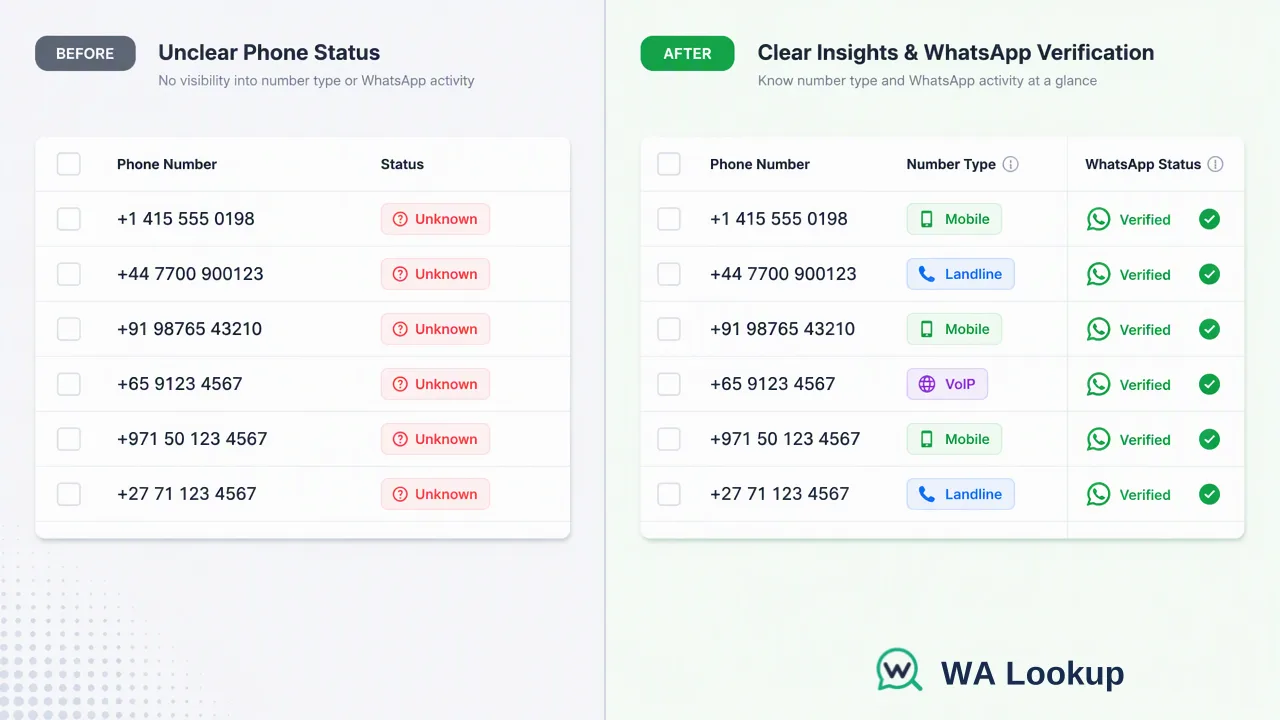
Understand the technical differences between mobile, landline, and VoIP line types, and learn how platform registration signals provide real-time reachability data for communication workflows.
Line type refers to the underlying telecommunications infrastructure—Mobile, Landline, or VoIP—associated with a phone number. While line type helps organizations determine the technical capabilities of a channel for SMS or voice routing, a platform registration signal provides a real-time, service-specific check of whether a number is currently reachable on a messaging platform like WhatsApp.
Defining Phone Number Line Types
Phone number line type classification categorizes the underlying telecommunications infrastructure that supports a specific identifier. Organizations use this classification to understand the baseline technical capabilities of a number before initiating outreach. The three primary line types are Mobile, Landline, and VoIP.
- Mobile: Mobile numbers operate on cellular networks. They natively support both voice calls and SMS text messaging, making them the standard target for mobile marketing, authentication SMS delivery, and direct messaging workflows.
- Landline: Landlines rely on the traditional Public Switched Telephone Network (PSTN) using physical copper wires or fiber optics. These numbers are traditionally voice-only. While some modern configurations allow text-to-landline routing, standard landlines drop standard SMS payloads, meaning organizations must route communications to these numbers via voice channels.
- VoIP (Voice over Internet Protocol): VoIP numbers route calls and messages over the internet rather than traditional cellular or PSTN infrastructure. Because they are not tied to a physical SIM card or geographic location, VoIP numbers offer high flexibility for business routing. However, some platforms treat VoIP numbers differently for verification purposes.
Why Line Type Matters for Communication Workflows
Understanding whether a phone number is a mobile, landline, or VoIP line informs how organizations structure their communication workflows. When teams process large contact lists, attempting to send SMS messages to landlines results in failed deliveries and wasted resources. By classifying the phone number line type mobile landline VoIP early in the data pipeline, organizations can optimize their routing logic. Teams use line type data to branch their outreach strategies. If a number is classified as a mobile line, the system can confidently queue an SMS or route the contact to a messaging workflow. If the number is a landline, the system can automatically redirect the contact to a voice-dialing queue or a customer support call center. This branching ensures that the chosen communication channel aligns with the technical capabilities of the receiving device. Additionally, line type classification supports internal data hygiene. Segmenting lists by infrastructure helps operations teams forecast messaging costs, allocate resources for voice campaigns, and maintain clean CRM records. However, while line type provides the foundational infrastructure category, it does not confirm whether the number is currently active or reachable on specific modern messaging applications.
Beyond Line Type: Platform Registration Signals
While line type classification identifies the physical or virtual infrastructure of a phone number, it remains a static data point. A number might be a valid mobile line but not registered on a specific messaging service. To determine actual reachability on platforms like WhatsApp, organizations require a platform registration signal. A platform registration signal is a real-time indicator confirming whether a specific identifier is currently registered and reachable on a designated messaging platform. WA Lookup provides a synchronous REST API to check WhatsApp registration status and account signals for a submitted phone number. Teams use WA Lookup to bridge the gap between knowing a number is a mobile line and knowing it can receive a WhatsApp message. The WA Lookup platform offers three distinct checks based on the service_type parameter:
ws: Returns a WhatsApp registration and account-presence signal.ws_avatar: Checks WhatsApp registration and adds profile enrichment, returningavataravailability andavatar_url(which may be an empty string).ws_business: Checks WhatsApp registration and adds abusinessprofile signal to indicate if the account uses WhatsApp Business.
By integrating these checks, organizations move beyond basic infrastructure classification and gain immediate context for their messaging workflows.
Practical Application: Integrating Registration Signals
Organizations integrate WA Lookup's synchronous REST API directly into their CRM platforms, lead-scoring systems, and communication pipelines to automate reachability checks. The API requires numbers to be submitted in E.164 format, ensuring standardized global processing. The integration relies on the POST /api/v1/check endpoint. Teams authenticate requests using the X-API-Key header and a Content-Type: application/json header. The request requires a JSON body containing the service_type and the identifier formatted as an E.164 number. Because the results are synchronous, the API returns the completed check in the initiating HTTP response. This same-response architecture eliminates the need for asynchronous task-submission, polling, or callback workflows, allowing automated systems to make immediate routing decisions. For workflows processing multiple contacts, WA Lookup provides a synchronous batch endpoint that accepts up to 100 identifiers in a single request. The endpoint processes the batch and returns the entire set of results in one response, or fails as a whole. This allows sales operations and support teams to validate small lists of numbers right before launching a targeted outreach campaign. The public data object returned by a completed check contains the service_type, identifier, and the registered boolean. If a check cannot be decided, the API returns a non-zero business code rather than a completed result object. Failed or undetermined checks are refunded automatically under the pay-per-check billing model. By utilizing these synchronous signals, teams ensure their communication workflows are informed by current platform reachability rather than relying solely on static line type classifications.
FAQ
Does line type determine if a number is registered on WhatsApp?
No. Line type classification only identifies the underlying infrastructure, such as whether a number is a mobile, landline, or VoIP line. It does not indicate whether the user has registered that specific number on a messaging service.
What is the difference between a line type check and a registration check?
A line type check categorizes the telecommunications network associated with a phone number. A registration check, by contrast, confirms whether the submitted number is registered on a specific messaging platform such as WhatsApp.
How do teams check WhatsApp registration status?
Organizations use the WA Lookup synchronous REST API to submit an E.164 formatted phone number via the POST /api/v1/check endpoint. The API returns a same-response signal indicating whether the submitted number is registered on WhatsApp.
How does the synchronous batch endpoint handle multiple numbers?
The WA Lookup synchronous batch endpoint accepts up to 100 identifiers in a single request. It processes the numbers and returns the whole batch in the initiating HTTP response, allowing teams to check small lists without implementing polling or callback systems.