
Product guidance
Validating International Phone Numbers for Cross-Border Commerce
Learn how international phone number validation and real-time platform registration signals support cross-border commerce communication workflows.
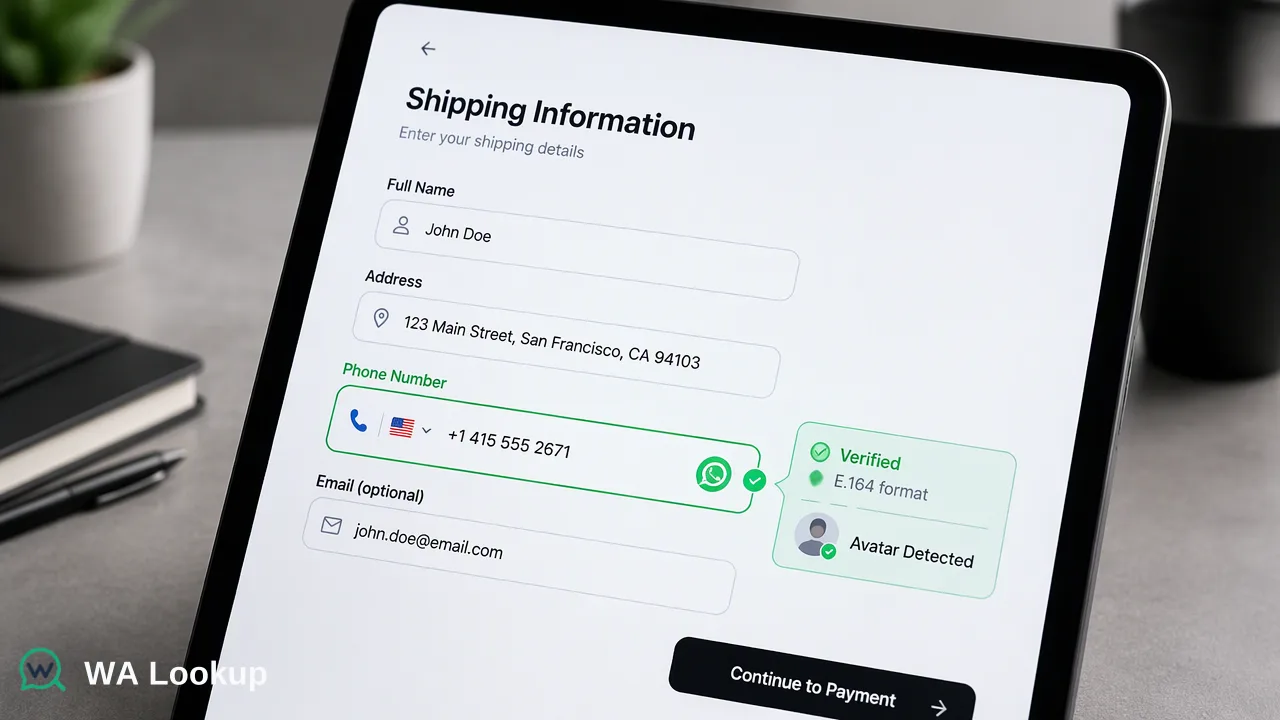
Learn how cross-border commerce teams use international phone number validation and platform-specific registration signals to optimize global messaging workflows.
For cross-border commerce, international phone number validation requires more than basic format normalization. While standardizing numbers into international formats establishes proper structural syntax, organizations must confirm platform-specific reachability to verify whether a destination endpoint can actually receive communications. By checking platform registration signals in real time, teams can determine whether an account presence exists on a specific messaging network at the exact time of contact, helping reduce message routing uncertainty and informing international customer engagement workflows.
The Challenge of Global Communication Reachability
Operating cross-border commerce operations introduces significant complexity to customer communications. Global businesses interact with buyers across multiple regions, each governed by distinct telecommunications frameworks, mobile numbering conventions, and regional messaging habits. In this environment, sending order updates, delivery notifications, or authentication prompts requires high confidence that the destination number can receive the message. Traditional international phone number validation often relies solely on syntax parsers. While these parsers confirm that a number contains the correct country code and digit count, they operate in isolation from live networks. A structurally compliant number may be unassigned, disconnected, or associated with a user who does not utilize the business's intended messaging channel. Cross-border merchants that rely exclusively on static formatting checks frequently encounter failed deliveries, delayed order confirmations, and wasted operational resources. Ensuring effective cross-border reachability requires verifying that the target communication channel is available for the submitted identifier.
Distinguishing Format Validation from Platform Registration
A robust communication pipeline treats international number formatting and platform reachability as two complementary, distinct stages:
- Format Normalization (E.164): The international public telecommunication numbering plan (E.164) standardizes phone numbers into a universal format including a country code, national destination code, and subscriber number, prefixed by a plus sign. Standardizing raw inputs into E.164 format ensures consistency across databases and APIs by eliminating spaces, hyphens, and regional trunk prefixes.
- Platform Registration Verification: Platform validation checks whether that normalized number corresponds to an account on a specific messaging network at check time.
While format validation confirms mathematical and structural compliance, platform verification confirms channel availability. A number can pass E.164 validation without having an account on a particular messaging network. Conversely, an international number cannot be verified on modern messaging platforms unless it is properly formatted. Integrating both layers allows teams to clean incoming customer data and verify reachability before initiating outreach.
Integrating Real-Time Signals into Commerce Workflows
In cross-border commerce, interaction timing is critical. Customer onboarding, order status alerts, and fulfillment updates require immediate validation to prevent delivery bottlenecks. Systems that rely on asynchronous task submission, polling queues, or batch file downloads introduce latency that can stall automated customer journeys. Synchronous REST API checks address this friction by returning registration signals in the same HTTP response as the initial request. When an international customer submits a phone number at checkout or within an account profile, the commerce backend can immediately dispatch a synchronous validation check. The returned decision can then route the communication: numbers confirmed as registered can receive messaging notifications, while unregistered numbers can be directed to fallback channels such as email or SMS. For bulk data maintenance, synchronous batch endpoints can evaluate collections of up to 100 identifiers per request in a single round trip, supporting high-throughput back-office cleansing without complex polling architectures. For operational governance, teams should consult current API documentation regarding documented per-user concurrency and timeout controls.
Operationalizing Global Number Verification
Organizations can tailor international phone validation by selecting specific check types depending on the communication context. Available verification checks on WhatsApp provide distinct signals:
| Verification Check | Service Type | Documented Account Signals |
|---|---|---|
| Standard Registration | ws |
Account presence (registered boolean) |
| Avatar Enrichment | ws_avatar |
Account presence, avatar availability (avatar), and profile avatar URL (avatar_url) |
| Business Signal | ws_business |
Account presence and business profile indicator (business) |
When teams manage merchant-to-merchant communications or supplier coordination, the business profile check provides additional context regarding whether the account operates as a business profile. Similarly, avatar availability provides profile enrichment context, but an absent avatar does not indicate an unregistered number. Utilizing these granular signals helps cross-border operations maintain clean contact lists, prioritize viable channels, and support responsive global customer operations.
FAQ
Why is platform-specific validation important for international numbers?
International phone numbers span hundreds of national dialing plans, mobile network codes, and regional conventions. While basic syntax formatting checks whether a phone number follows national and international digit patterns, it cannot verify whether the number is actively provisioned on a specific communication channel. Platform-specific validation provides an account-presence signal directly from the target network, informing routing decisions before sending time-sensitive commerce notifications.
How does platform registration status impact cross-border delivery?
Platform registration status indicates whether an account is present on the designated messaging network when queried. Obtaining a registered signal helps teams prioritize viable channels and redirect unregistered records to alternative customer contact methods.
Learn More
Choose the product information that fits the next step in your workflow.