
Product guidance
Format Validation vs Live Verification: What You Actually Need
Compare format validation vs live phone verification to understand when to use syntax checks and when to rely on synchronous platform registration signals.
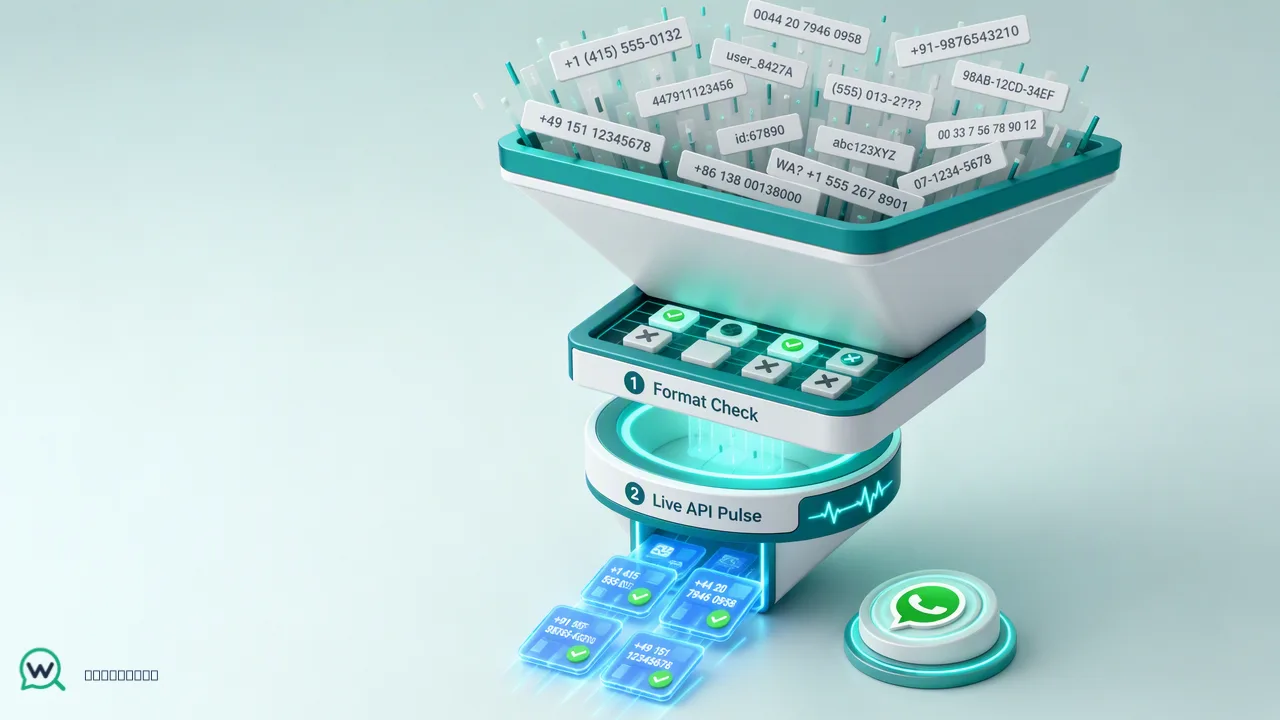
A technical comparison of format validation and live phone verification, detailing when to use static syntax checks and when to implement synchronous platform registration signals.
Format validation checks if a submitted phone number string conforms to expected structural rules, such as the E.164 standard, without querying external databases. In contrast, live phone verification performs a synchronous check against a specific platform to confirm whether the number is currently registered. While format validation provides basic data hygiene for initial input sanitization, live verification returns an account-presence signal that helps teams segment lists and inform communication workflows.
Understanding Format Validation
Before a phone number can be checked against a live platform, it must be structurally sound. Format validation is a local, static process that evaluates a number's syntax. This step ensures that the submitted string contains the correct country code, area code, and digit length required by international standards. For example, the WA Lookup API requires all submitted numbers to be in E.164 format. Running a format validation step in your data pipeline ensures that malformed entries are caught early, reducing unnecessary API calls. This method is highly efficient for initial data entry sanitization, but it cannot confirm whether the number is actually attached to a registered account on a messaging platform.
The Mechanics of Live Platform Verification
Live verification moves beyond syntax by querying the platform directly. This process uses a synchronous REST API to request the current registration status of a submitted phone number. The result is returned in the same HTTP response as the request, making it suitable for real-time workflow integration.
For a completed WhatsApp check, the returned data contains service_type, identifier, and registered; ws_avatar also includes avatar and avatar_url, while ws_business includes business. Internal record, transaction, status, and billing fields are not returned.
Comparing WhatsApp Verification Signals
When implementing live verification for WhatsApp, the specific signals returned depend on the selected check type. WA Lookup offers three distinct service types through a single synchronous endpoint, allowing teams to tailor the request to their workflow needs.
- WhatsApp Checker (ws): This check confirms whether a submitted phone number is registered on WhatsApp. It returns the registered field, providing a baseline account-presence signal.
- WhatsApp Avatar Checker (ws_avatar): This check includes the baseline registration status and adds an avatar boolean and an avatar_url string. The URL is empty when no address is available, supporting profile enrichment workflows.
- WhatsApp Business Checker (ws_business): This check confirms standard registration and adds a business boolean to indicate whether the account uses WhatsApp Business. This signal helps teams segment business contacts from standard accounts.
Failed, timed-out, and undetermined checks do not retain the charge. See the pricing page for current billing details.
Decision Framework: Which Do You Need?
Choosing between format validation vs live phone verification depends on the specific stage of your data pipeline.
When to rely on format validation:
- During initial user onboarding or web form submission to catch typos.
- When standardizing legacy databases into the E.164 format.
- As a prerequisite step before initiating any live platform checks.
When to implement live verification:
- When your workflow requires an account-presence signal to segment audiences.
- When you need to differentiate between standard and business accounts using the ws_business check.
- When profile enrichment is necessary, utilizing the ws_avatar check to retrieve available avatar URLs.
Live verification results report the platform status available at the time of the check. This signal informs internal decisions and supports prioritization alongside other data checks.
Managing Verification Workflows
Integrating live verification requires visibility into usage and performance. The WA Lookup dashboard supports API key management, allowing administrators to securely configure their integration. Operators can monitor their balance, review check history, and access product-level reporting. The dashboard provides insights into recent checks, balance spend, and account activity, giving teams the context they need to manage their verification volume effectively. For teams evaluating the platform, new accounts can contact support for 100 free checks to test registration, avatar, and Business account checks before scaling their operations.
FAQ
How is a live verification request structured?
The documented request contract is a POST /api/v1/check with an X-API-Key header and a JSON body containing the service_type (ws, ws_avatar, or ws_business) and the identifier (an E.164 formatted number).
Are live verification results delivered asynchronously?
No, the results are synchronous. The account-presence signal is returned in the same HTTP response as the request, rather than being delivered asynchronously.
What fields are included in every check response?
For a completed WhatsApp check, the returned data contains service_type, identifier, and registered; ws_avatar also includes avatar and avatar_url, while ws_business includes business. Internal record, transaction, status, and billing fields are not returned.
How does the billing model work for different check types?
Failed, timed-out, and undetermined checks do not retain the charge. See the pricing page for current billing details.