
Product guidance
How to Evaluate AI Communication Platforms for Regulated Industries
Learn how to evaluate AI communication platforms for regulated industries with a focus on data sovereignty, auditability, human oversight, and data hygiene.
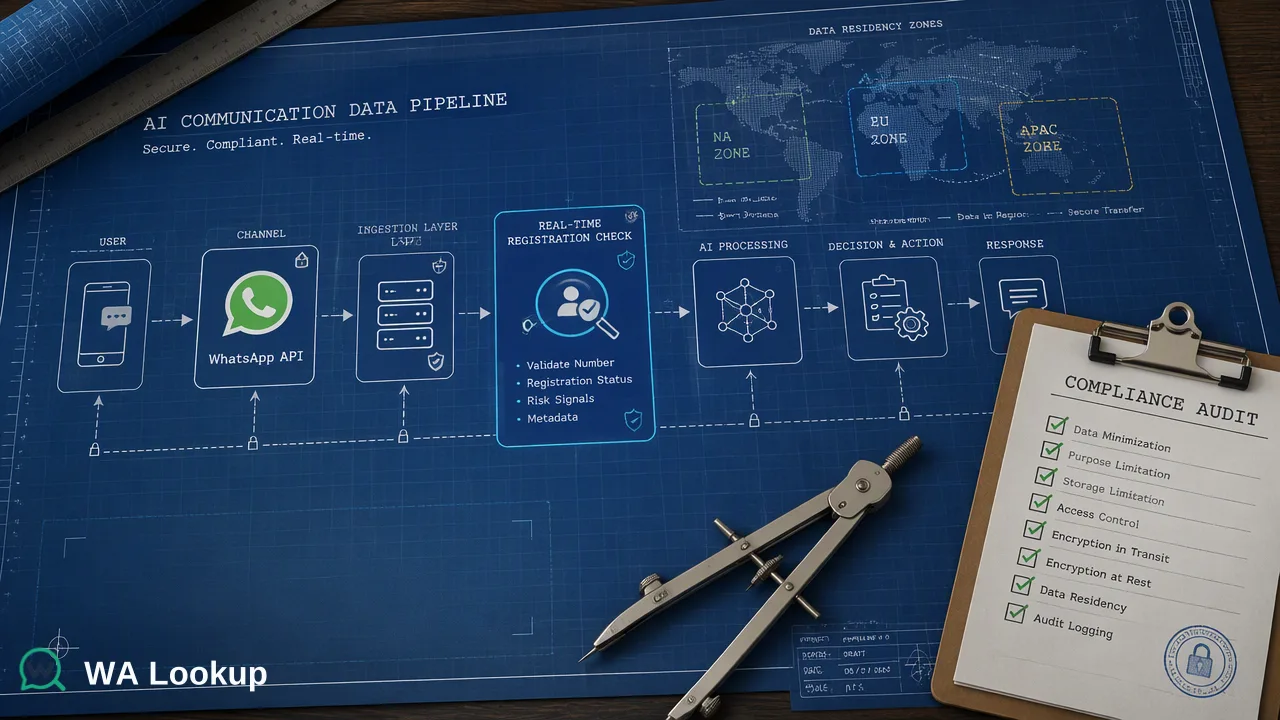
A practical framework for evaluating AI communication platforms in regulated sectors, covering data sovereignty, audit trails, human oversight, and data hygiene.
Evaluating AI communication platforms for regulated industries requires assessing data sovereignty, automated decision logging, human-in-the-loop escalation paths, and rigorous data hygiene. Regulated organizations must verify that communication infrastructure complies with local data residency requirements, captures verifiable audit records for every interaction, and supports data minimization principles. Integrating real-time account-presence checks before message dispatch helps teams maintain accurate routing records, reduce transmission errors, and protect operational integrity across high-trust customer channels.
The Compliance Imperative in AI Communication
Deploying artificial intelligence across customer communication channels introduces operational efficiencies, but regulated sectors such as financial services, healthcare, and legal counseling face strict governance requirements. When evaluating AI communication platforms, organizations must balance conversational automation against regional statutory mandates and privacy frameworks.
A primary consideration is compliance with data protection laws. Under GDPR Article 5 (Regulation (EU) 2016/679), personal data must be adequate, relevant, and limited to what is necessary for the purposes for which it is processed. In an automated conversational context, this requirement calls for strict data minimization. Contact centers must evaluate whether an AI platform retains unnecessary conversational transcripts, sensitive personal attributes, or extraneous metadata.
Regulated organizations also face sector-specific outreach rules. For example, the WhatsApp Business Messaging Policy requires businesses to receive opt-in permission before sending messages to consumers. Platforms operating in these environments must facilitate strict consent validation, verifiable records management, and structured policy adherence across every automated touchpoint.
Ensuring Data Sovereignty and Auditability
Data sovereignty mandates that digital information remains subject to the laws and governance structures of the nation or jurisdiction where it is collected and processed. When selecting communication technology, regulated teams must verify where platform infrastructure, conversational inference models, and transient message logs physically reside.
Local hosting configurations help organizations satisfy national data residency obligations and protect sensitive consumer records from cross-border legal conflicts. Teams should inspect whether vendor hosting facilities, backup environments, and model execution pipelines operate strictly within designated sovereign borders.
Alongside hosting sovereignty, automated decision logging remains essential for operational auditability. AI platforms must record structured event logs that trace every automated interaction. A comprehensive audit trail captures:
Inbound channel metadata and normalized destination identifiers
Model prompt templates, inference inputs, and versioned policy rules
Automated triage logic, intent classifications, and confidence scores
Timestamps for verification events, routing decisions, and human escalations
These automated logs provide supervisory bodies and internal compliance auditors with clear visibility into system behavior during compliance reviews.
Integrating Real-Time Verification for Data Hygiene
Automated communication workflows depend on high-quality contact records. Transmitting automated messages to stale, decommissioned, or invalid phone numbers creates communication failure points, misallocates messaging budgets, and complicates data hygiene audits.
Formatting destination numbers according to international telecommunication standards establishes baseline consistency. ITU-T Recommendation E.164 defines the international public telecommunication numbering plan, specifying that a standard international number begins with a country code and contains at most 15 digits. Normalizing numbers into this standard format prepares records for routing systems.
Beyond format checks, integrating real-time account-presence verification provides timely routing context. WA Lookup delivers synchronous check endpoints that query account presence before a message is queued. For WhatsApp channels, a completed registration signal reflects an account-presence signal at check time, helping teams review routing paths and maintain database hygiene before automated workflows execute.
Organizations can choose check types based on operational requirements:
| Check Type | Input Scope | Primary Returned Signal |
|---|---|---|
WhatsApp Registration Check (ws) |
E.164 phone number | Platform registration status |
WhatsApp Avatar Check (ws_avatar) |
E.164 phone number | Registration status, avatar availability, and avatar URL |
WhatsApp Business Account Check (ws_business) |
E.164 phone number | Registration status and WhatsApp Business account indicator |
For smaller synchronous workflows, API checks return results in the initiating response, supporting immediate routing decisions. For large contact databases, asynchronous bulk file tasks process single-country lists of country-coded numbers, delivering structured result files to clean legacy CRM stores.
Designing for Human Oversight and Containment
A common trap when deploying conversational AI in contact centers is evaluating success purely through deflection rates. High deflection metrics can conceal unresolved consumer issues or improper automated answers. Regulated industries instead prioritize containment quality, assessing whether the AI successfully resolved the customer inquiry within regulatory and policy guidelines.
Designing robust human-in-the-loop workflows requires structured handover protocols between automated agents and live compliance or support specialists. Platform evaluation teams should inspect:
Trigger criteria: Clear thresholds based on consumer intent detection, negative sentiment, repeatedly ambiguous inputs, or explicit compliance keywords.
Context preservation: Full conversational history, metadata, and pre-dispatch verification results transferred to the human agent desktop.
Warm transition workflows: Structured conversational closures that signal to the user that a qualified human staff member is assuming responsibility for the interaction.
This balance supports efficient resource allocation while preserving human intervention for complex, high-risk consumer inquiries.
Mitigating Vendor Lock-In With Substitution and Exit Strategies
Regulated institutions must maintain operational continuity even if a third-party vendor alters its terms, raises licensing costs, suffers technical disruptions, or fails a compliance audit. When evaluating AI communication platforms, procurement and risk committees must require defined substitution and exit strategies.
Architectural decoupling forms the foundation of vendor independence. Organizations should favor platforms that support open messaging APIs, standardized schema definitions, and portable decision engines. Isolating the conversational layer, telephony orchestration, and identity verification services into modular components prevents deep dependencies on proprietary monoliths.
Teams should also review contract terms regarding data portability. Regulated entities must retain complete ownership of conversational transcripts, prompt engineering libraries, customer interaction histories, and audit records. Verifying that these assets export easily in standard structured formats helps organizations transition between providers smoothly when strategic or regulatory needs demand it.
FAQ
Why is real-time verification important for regulated communication?
Real-time verification provides an account-presence signal at the moment of outreach, helping teams confirm destination status before dispatching automated communications. This check supports contact database hygiene and informs routing engines, reducing misdirected traffic across regulated channels.
How does data minimization impact AI communication platform selection?
Under GDPR Article 5 (Regulation (EU) 2016/679), personal data must be adequate, relevant, and limited to what is necessary for the purposes for which it is processed. Regulated platforms must support data minimization by scoping payload collection strictly to necessary operational fields, avoiding excessive data retention across AI conversational memory.
What role does human oversight play in AI contact workflows?
Human oversight provides escalation boundaries for complex inquiries, ambiguous intent, and compliance-sensitive workflows. Clear agent handover protocols help teams review edge cases, uphold regulatory standards, and maintain conversational quality beyond basic containment metrics.
How can organizations maintain auditability in automated messaging workflows?
Auditability relies on structured, immutable decision logs capturing inbound user inputs, AI model decisions, confidence thresholds, external verification checks, and final routing paths. These logs support supervisory review and internal compliance assessments.
Learn More
Choose the product information that fits the next step in your workflow.