
Product guidance
WhatsApp Webhook Automation Best Practices: The Synchronous Alternative
Learn WhatsApp webhook automation best practices by replacing complex polling with a synchronous REST API for real-time number validation.
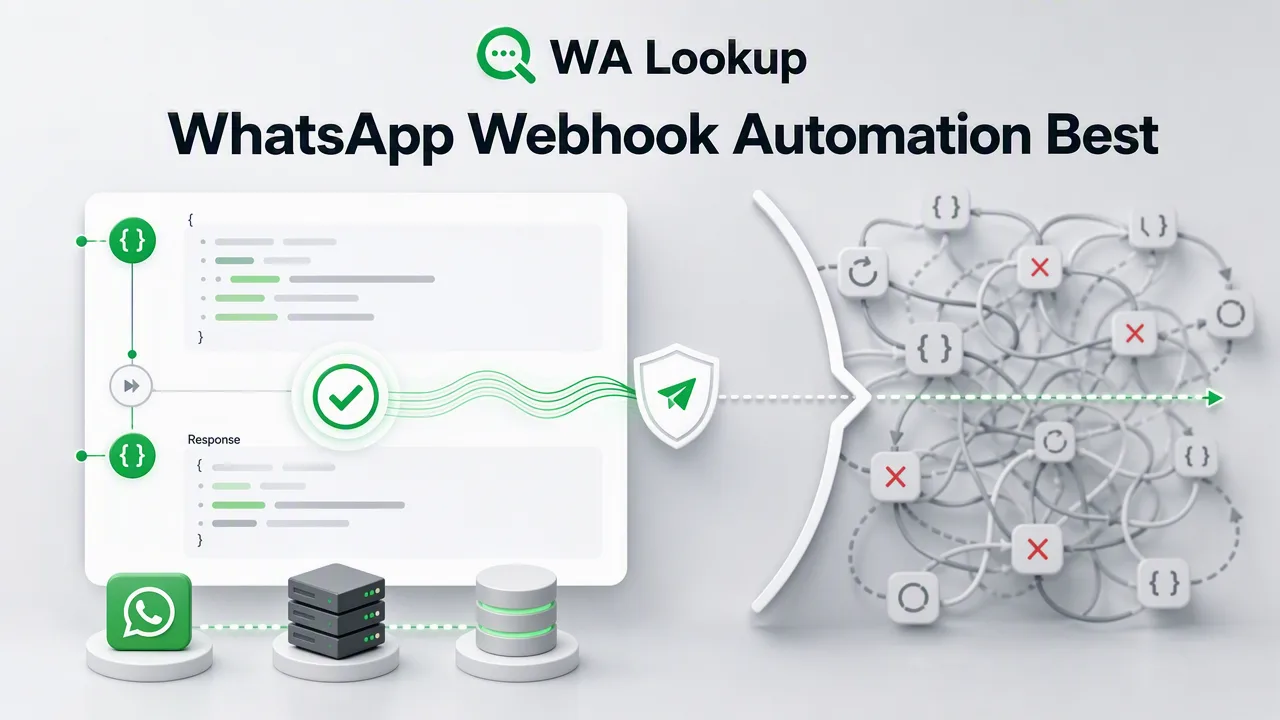
Learn why replacing complex webhook architectures with a synchronous REST API streamlines WhatsApp number validation and reduces integration overhead.
Many WhatsApp integration bottlenecks stem from complex webhook architectures that require polling, error handling, and infrastructure maintenance. By using a synchronous REST API, developers can verify WhatsApp registration, avatar availability, and business account status in real-time within a single HTTP request. This approach removes the need for webhooks, reduces integration complexity, and provides an immediate account-presence signal to inform CRM and lead management workflows.
The Hidden Costs of Webhook-Based Validation
Traditional WhatsApp webhook automation best practices often focus on managing the complexity of asynchronous callbacks. Webhooks introduce significant infrastructure overhead, requiring development teams to build polling mechanisms, manage callback endpoints, and handle delayed responses. When the goal is simply to validate whether a phone number is registered on the platform, deploying a full webhook architecture creates unnecessary latency and maintenance burdens. Instead of waiting for an asynchronous event to confirm an account-presence signal, teams can streamline their workflows by moving away from webhook dependency for basic validation tasks.
The Synchronous Advantage
A synchronous API offers a more efficient integration pattern where the request and response occur within the same HTTP connection. This means results are returned in the same HTTP response as the request, completely removing the need for polling or webhook setup. For CRM operators and sales-ops teams, this synchronous check provides immediate context for a submitted number. By receiving the validation data instantly, systems can route records or update lead lists without holding connections open or managing complex asynchronous queues.
Implementing WhatsApp Status Checks
Integrating a synchronous validation workflow requires minimal setup compared to webhook management. The process relies on a single endpoint: POST /api/v1/check. Developers authenticate using an X-API-Key header and submit a JSON payload containing the target phone number in E.164 format alongside a service_type parameter.
Because the system operates on a pay-per-check model, billing is straightforward. Failed or undetermined checks are automatically refunded, meaning teams only consume their balance for usable results. New accounts can also utilize a $0.10 trial balance to test the integration. The platform dashboard supports ongoing management by providing access to API keys, balance spend, check history, product-level reporting, recent checks, and 7-day trends.
Choosing the Right Verification Product
All validation requests use the same synchronous endpoint, with the service_type parameter controlling which fields are returned and which balance cost applies. Teams can select the check that best fits their workflow input needs:
| Service Type | Capability | Returned Fields |
|---|---|---|
ws |
Confirms WhatsApp registration status. | registered |
ws_avatar |
Checks registration, avatar availability, and avatar URL. | registered, avatar, avatar_url |
ws_business |
Checks registration and WhatsApp Business account status. | registered, business |
Every check response also includes standard fields such as id, identifier, transaction_id, status, service_type, and charged_amount_micros. These account-presence signals help teams segment audiences effectively without relying on asynchronous webhook events. |
FAQ
Why is a synchronous API better than webhooks for validation?
A synchronous API returns results in the same HTTP response as the request. This removes the need to build polling mechanisms, manage callback endpoints, or maintain the complex infrastructure typically required for webhook-based validation.
What format should phone numbers be in for the API?
All submitted phone numbers must be formatted in E.164 format to ensure accurate processing by the API.
How does the billing model work for failed checks?
The platform uses a pay-per-check model where failed or undetermined checks are automatically refunded, meaning balance is only consumed for successful validation attempts.
Does the API check if a number is currently online?
No. A registered result reports the WhatsApp status fields available at the time of the check. It does not check online status, last seen, message history, consent, or whether the number can be contacted.